Lecture 1: Introduction to Biology: Class description, what to expect, projects, grading, Scientific Method
My name is Rex Fujiwara and welcome to Highschool Biology. We are home school parents teaching our kids and hope to provide a fun or less boring way of learning. I have a bachelor’s of degree in biological sciences and a master’s degree in physical therapy. I have an interest in pain science and would eventually like to pursue a PhD in neurophysiology.
The main textbook for this course is CK-12 Biology for high school students and reading assignments are at www.ck12.org. Video lectures will be based off of the CK-12 textbook, but there will also be lecture material that is not found in the text. Written copies of video lectures will also be available for review. Weekly tests will be based off of video lectures and textbook. There will also be extra credit points assignments available.
Grading
Weekly Quizzes 350 points
Biology Project: 50 points. Become an expert on a topic. Pick a topic and share it! This topic can be related to anything associated with biology. It must be PG13. This is something that should take a couple of months time to complete.
Article Review: 25 points You will pick an article related to biology and critique it. What are the positives, negatives, and bias. We will go into more details about this.
Midterm 50 points
Final: 50 points
Extra Credit TBA
You may have questions or issues with quiz or test questions: We do our best to make fair yet challenging exams. In the process, some of the questions and answers can be ambiguous or simply incorrect. Students will be given credit for these errors.
Also, each week, we will go over a field within biology to help you find something that you may be interested in. In addition, we will go over past or present figures in various field and provide further readings and videos. These additional topics will give opportunities for extra credit assignments. Here is a list of common fields in biology:
| Types of Fields in Biology | ||
| Anatomy Biochemistry Biomedical Sciences Biostatistics Biotechnology Botany Cell biology Chemistry Conservation biology | Developmental biology Ecology Ethology Entomology Environmental science Genetics Genomics Human biology Immunology | Marine biology Microbiology Molecular biology Neuroscience Teaching / Professor Physiology Researcher Zoology |
Welcome to high school Biology. Over the next couple of days, we will introduce biology and go over a few concepts that are the foundation to understanding the scientific method.
Vocabulary list for this week.
Validity
Reliability
Correlation vs causation
Cause and effect
Biology is the study of living organisms. This includes plants, animals, insects, parasites and even viruses. There are also many different fields within biology and some of you may be interested in pursuing it in college. Some of you may want to become a nurse, doctor, vet, teacher, a marine biologist, or a scientist as examples.
Image of careers
Some of you have no interest in biology or might not be sure and you are taking this class because you have to take a science class, and that is okay. Maybe taking this class may even spark an interest. But, regardless of your interest level, we hope to show you how biology or science in general is important in everyday life.
You might be wondering, how is biology and the scientific method important in everyday life?
Let’s look at some examples:
Unilad.com is a site that shares news throughout the world. In their video here, they indicated that driving in France is not safe. There are remarks about driving in France based upon observations that you can see here:
See how they state that “it’s hard to tell if this driving is impressive, or extremely dangerous”. At first glance, we might feel that we will never want to drive in France. But this video is not a valid representation of France at all.
Within science, there is something called validity and are over 10 different types of validity, but in its simplest form, a test or statement is valid if it represents what it is supposed to represent. This video is not valid because it represents one round-about in France called the “arc de triomphe circle” and not France as a whole. It is not recommended to drive in this area and insurance companies may settle all accidents 50-50 regardless of who is at fault. Understanding concepts of validity will help us become more critical of things that people say including the news and things that are posted on the internet because a high percentage of information posted on the online may be wrong. As an example, over half of the information regarding low back pain found online may be incorrect!
One reason information in the medical field can be incorrect is because it can take on average 17 years for medical information to become common knowledge once it is published!!
accuracy of tiktoks
You may have heard the term “trust the science”. But what we need to understand is how to question it to find out if scientific information is correct or up to date!
Understanding validity is a step towards understanding how to incorporate science in our lives and most importantly to know if we can trust it.
Let’s go over some of the types of validity. We will not go over all 10 different types, but this is a good start.
| Type of Validity | Definition (from Portney and Watkins Foundations of Clinical Research Applications to Practice) | Examples |
| Face validity | The assumption of validity of a measuring instrument based on its appearance as a reasonable measure of a given variable. (Does it pass the eye test. Does it appear to be valid) | 1. A biology test to show that a student is knowledgeable of lecture material passes the eye test. 2. Using a thermometer to measure temperature would pass the eye test. touching an object to guess temperature wouldn’t. 3. If we were to measure how fast someone is running. a stop watch passes the eye test. Counting using “one thousand one, one thousand two…” does not pass the eye test if we need to be accurate. |
| Construct validity | The degree to which a theoretical construct is measured by an instrument. (A test that measures what it is intending to measure.) There is usually a standard and the instrument is compared to the standard. | 1. Does the biology test measure knowledge of the lecture material or are the test questions irrelevant? 2. A measuring tape has more construct validity than using our shoes to count steps to measure distance. |
| Content validity | The degree to which an instrument adequately reflects the content domain being measured. (A test that fully represents what it is supposed to measure.) | 1. How well does the biology test measures all aspects of the material adequately. Are there parts of the test that are not relevant? 3. How accurate is the measuring tape. |
| Internal validity | The degree to which the relationship between the items tested are free from the effects of extraneous variables or errors. (All factors that can affect the research project are eliminated or accounted for.) | 1. Are there factors that will affect the biology test that are not accounted for? For example, a question that doesn’t make sense or did the lack of sleep affect the ability to perform well on the test? 2. Is the measuring tape worn out? is it accurate?, is there enough lighting to see the measurements. does the person measuring need glasses? |
| External validity | The degree to which results of a study can be generalized to persons or settings outside the experimental situation. | 1. Can a research study on rats mean that people in real life will respond in the same way? Many medications start with research on rats before humans. 2. Classic signs of heart attack involved chest pain and pain down the left arm. But these studies were performed on men. These studies lack external validity for women. It was found that there were other symptoms such as pain down the right arm, pain over the neck, back, jaw, and stomach, shortness of breath, stomach ache when women were included in these studies. |
| Reliability | The degree of consistency with which an instrument or rater/user measures a variable. (Is the test reliable and is the user of the test reliable?) | 1. Will a scale measure the same weight every time it is used? 2. Will a user measure the same distance every time with the same measuring tape? 3. How consistent is a police radar gun used to measure speeding cars? how often do police officers make mistakes when using a radar gun to measure speeders? |

Understanding validity and reliability it very important and if you would like to look more into types of validity, you can check out helpfulprofessor.com.
Another important concept in science is the understanding that correlation does not mean causation. What this means is that just because two things happened, it does not mean that one thing caused the other. Some research studies collect information from surveys and then report on correlations and some may mistake it with causation. Sometimes it might seem like one caused the other, but it may not. This is a common mistake to make. Let’s take a look at these charts in an article by Harvard Business News:

As you can see there is a correlation between iPhone sales and deaths caused by falling downstairs. This shows a correlation but one does not cause the other. Of course, if someone is walking down steps and not paying attention because they are on their phone, well, that can cause a fall. The same goes for the other graphs. There is a relationship of increased spending on admission to spectator sports with consumption of high fructose corn syrup and new car sales with visitors to Orlando’s Island of Adventure. But one does not cause the other.
This is an Instagram post from a physical therapist explaining a real-life example of potentially misunderstanding association vs causation.
The speaker in this video is explaining how toe weakness is associated with falls but it is not the main reason why people fall. strengthening of the entire body is what is needed.
If correlation does not mean causation or one thing caused another, how do we prove Cause and Effect?
We have gone over quite a bit so lets just take a quick break and take at look at these two animals. I’m not sure what is going on here!
Take a few deep breaths!
So let’s get back to cause and effect. How do we prove something will cause another thing? Why do we need prove cause and effect? Looking back at the video about training toe strength and falls, we need to:
1. Create an experiment to test it out. There was a report that showed correlation of decreased toe strength and falls, so in this video the doctors stated that training the toes is the most important thing to do to prevent falls. But does toe weakness cause falls? Since we talked about validity, would you say that this statement has face validity? In other words, does it look like a good statement? I think there is no right or wrong answer here so it is okay if you say yes or no. I would personally say no because I am not aware of any research that has actually tested this and guidelines for fall prevention don’t discuss this as a primary factor.
2. Establish that the cause occurs before the effect with repeated studies consistently over time with different settings and populations. Is toe weakness the factor that causes falls? or do people that fall end up being less active thus causing weakness? It turns out that it is very common for people to become weak after an injury due to less activity tolerance.
Does more of an item have a greater effect? does less create a decreased effect? These are things that would be important to know.
Currently, there are no studies comparing toe exercises vs general strengthening exercises in fall prevention.
3. Think of things that will also play a role. What would disprove that point we want to make.
People with toe weakness many have weakness and decreased balance throughout the body that play a larger roll in fall prevention.
Things life fear of falling, general weakness, decreased balance, history of falls are risk factors. Do people with toe weakness have these other factors?
4. Many studies have to have the same results then we can start of infer cause and effect. At the moment here is not enough data to state that toe weakness is the most important thing to train to prevent falls.
It is very difficult and takes a lot of effort to prove cause and effect. But this understanding is very important so that we can distinguish associations vs cause and effect.
For further optional viewing, here is a video by Khan Acadamy going over the difference of correlation vs cause and effect.
So far we have gone over topics including validity, reliability, and correlation vs causation, cause and effect. and next we will go over Scientific inquiry / investigation and the scientific method.
Scientific inquiry and investigation
Scientific method
Hypothesis
Theory
Primary Source
Secondary Source
Scientific inquiry and investigation are often terms that are interchangeable. It involves finding a question and trying to figure out the answer. The scientific method is a specific way to think of a question, test the question, then find an answer.
If you were to look up the exact definition of the scientific method, Mariam-Webster Dictionary defines it as “principles and procedures for the systematic pursuit of knowledge involving the recognition and formulation of a problem, the collection of data through observation and experiment, and the formulation and testing of hypotheses.”
It is helpful to understand dictionary definitions of words and concepts, but it is also important to know what things mean in its simplest form using our own words. Additionally, this is just a definition and does not explain how to use the scientific method, which is what we will do next.
Now, let’s take a moment to think. Do you have anything you would like to investigate? Yes it’s the first week of class and I am asking you to think. Well what do you know!

Let’s take a few minutes to write down your thoughts. You can use the notes that were provided. Pause the video if you need time to grab paper and a pen or pencil. Or you can use a word document on your computer or tablet. You can even do an internet search to look for ideas. Sciencebuddes.org has a list of tons of ideas!
Any topic is fine. For example, have you heard of the 5 second rule for food that is dropped? what the best lemonade recipe? Does stretching before a sporting even prevent injuries? You can think of any question. there is no right or wrong answer here. Go ahead and pause the video to think.
Don’t worry if you do not have any ideas yet because we can use my ideas for now.
Must of you may have heard of the 5 second rule. If you haven’t It’s a saying that food that is dropped can be eaten as long as it doesn’t stay on the floor or the ground for greater than 5 seconds. Is “the 5 second rule” good to follow when we drop something on the floor?
Here are some other questions that are quite common.
Can a potato be used to light a lightbulb?
Do you live next to a stop sign? How many cars do a complete stop when driving by your home? Do most car just zip on by? This is something you can observe from the safety of your home.
Do you like to make homemade lemonade? What is the perfect amount of sugar and lemon juice needed for the right amount of sweet and sour flavor for the best lemonade?
For me, being a physical therapist. I once wondered if stretching will prevent injuries.
Using the scientific method, we can create a plan to find questions and answers. Sometimes, we might find what we expected, sometimes we might not get the answer we wanted, and often times we end up with more questions, whether we were right or wrong.
Now, let’s look at how the scientific method works.
The Scientific Method:
making observations – creating a question – researching the topic – create a hypothesis –
experiment – collect data – analyze the data – make conclusions – report findings
First, we need to make observations. Use our all of our senses including touch, taste, smell, vision, hearing depending on what our question is.
- For the 5 second rule: We notice that sometimes dirt gets on our food after it is dropped, sometimes it isn’t that bad and doesn’t affect taste so some will eat food if it’s dropped. We have used taste, vision, and touch.
- If you are curious if a potato can light up a light bulb: Some of us have heard or read that a potato can be used.
- For the Stop sign question: We may have read in the news that there have been more accidents in the neighborhood. We often hear cars zooming by. We may also have seen cars that haven’t stopped at the stop sign by our home.
- Lemonade recipe: We have tasted many types of lemonade. Some were better than others.
- Stretching: I was told that stretching will prevent injuries. Coaches recommend stretching when I was on the track team and we can feel our muscles pull while performing it. I’ve read numerous studies on this topic.
Create a question: After making an observation. We may come up with questions.
- The 5 second rule: Are there are more germs on food if it is left on the ground for more than 5 seconds compared to less than 5 seconds? Does it even matter?
- Potato to light up a light bulb: Will a potato actually light up a light bulb?
- Stop sign: What percentage of cars make a complete stop?
- Lemonade recipe: What is the perfect amount of sugar and lemon juice for lemonade?
- Stretching: Does stretching before a sporting activity prevent injury?
Research the topic: There are two types of research. The first type where we look something up. You might hear someone say “I’m going to research that”. The second is performing our own research study. Both types of research require time to understand a topic to the highest level possible. We must find out what is already known about the topic. Consulting an expert in the field can also be valuable but not always necessary.
When we are reading a research paper, a report published directly by researchers is called a primary source. In the field of biology, this can be from the New England Journal of Medicine or the Journal or Orthopedic Sports Physical Therapy as examples. Google Scholar and PubMed are some of the sites that we can search for articles.
A secondary source could be a newspaper, magazine, or blog such as the New York Times and US Magazine. Authors of a secondary source will discuss a primary source, make their own interpretations, and critiques.
Both primary and secondary sources are important. A systematic review of a topic is a secondary source that looks at all primary sources on a topic and can give a fair and comprehensive review of what has been published.
Here are other non biology and real life examples of primary and secondary sources.
| Primary source | Secondary source |
|---|---|
| Novel | Article analyzing the novel or a book report |
| Painting | Exhibition catalog explaining the painting |
| Letters and diaries written by a historical figure | Biography of the historical figure |
| Essay by a philosopher | Textbook summarizing the philosopher’s ideas |
| Photographs of a historical event | Documentary about the historical event |
| Government documents about a new policy | Newspaper article about the new policy |
| Music recordings | Academic book about the musical style |
| Results of an opinion poll | Blog post interpreting the results of the poll |
| Empirical or research study | Literature review, a magazine article , or blog about the study |
| Positives | Negatives | |
| Primary source | Information and materials are in their original form without it being changed. | We might not have the skill to interpret information. We may lack ability or skill to interpret information if original source is in a different language or too complicated. |
| Secondary Source | An interpretation of the primary source is provided. | Is the secondary source trustworthy? Is there bias? Did the secondary source misinterpret the primary source? |
If we look at the negatives, of primary and secondary sources of information. How do we know that we can trust what we are told? We need to understand how to interpret information. The most simplest is by knowing the data. In this video Dr. Lustig, a famous doctor who has written may books. But at the 2 hour 28 minute mark, he talks about different drinks and the effects of weight loss or gain.
Dr. Lustig reported that people were given 1 liter of regular soda, milk, diet soda, or water to drink every day for 6 months which resulted in the following:
regular soda : gained 10 kilograms
milk = no change
diet soda: gained 2 kilo
1 liter water: lost 2 kilo

Data from the actually study shows that changes were calculated by percentage of body weight, and the only group that lost weight was the diet soda group.
It is possible that he did not remember the data correctly or he purposefully gave the wrong information to back up his claim. This shows that it is okay to question any information that is given to us even from high levels of authority.
Here you can see two very different statements about eating eggs. So who is right? This is an example how there may be data supporting both statements.
As more data is published, the answer can become clear and our minds can change. It turns out that for most people, cholesterol from eggs play a small role in blood cholesterol levels, except for the small percentage of people who are sensitive to the cholesterol that is eaten. This shows the importance of performing thorough research on a topic.
One way to know if a research article or report is likely to be better than another is to know the rank order for types of research.

This is a research pyramid. It is a way to visualize both the quality of evidence and the amount of evidence available. On the bottom of the pyramid is expert opinion without any specific scientific proof and everyone has an opinion. The actual evidence is based on experience and is called anecdotal. The problem with anecdotal evidence is that it there is not much proof except saying that something happened. But can we trust what we see? Here is a video of an optical illusion. Which direction is the dancer turning? With practice, you can see the dancer spin in either direction. What we see can be influenced by what we want to see. That is one reason why expert opinion is the lowest form of evidence.
Case reports and case series are the next best thing. Dr. Epley was an ENT (ear, nose, and throat doctor) who created something called the “Epley Maneuver” to help with vertigo. It is a type of dizziness. In one of his first publications, he reported a case series of 10 test subjects improved who improved 100% of the time as you can see here. This was published in 1991. The only copy that I have is a little blurry. Sorry about that.

Observational studies: Researchers observe subjects and collect data. There is no manipulation of variables and what you see is what you get. Results are based on real life meaning there is stronger external validity. But there will be a high number of confounding variables that affect data. For example, let’s say that researchers want to know if a new medication is more effective and safer than current medications. If an observational study showed that the new medication is better, they will not know the exact level of diet, exercise, stress, or other behaviors affected their results because these factors were not controlled. They can use surveys to estimate but will be less accurate.
Nonrandomized control studies: Researchers try to control as many factors as possible. Let’s say that the new medication does not work as well if people eat grapefruit. The researchers will ask all participants to stop eating it. This will prevent that factor to effect results. Oftentimes treatments are compared to a placebo in order to show that the treatment is better than no treatment. A placebo can be a fake pill or treatment. These control studies are called nonrandomized because test subjects can pick whether they are in the placebo group or test group. The problems with this is that
Randomized controlled trials are studies in which the participants are divided by chance into separate groups that compare different treatments or other interventions. Using chance to divide people into groups means that the groups will be similar and that the effects of the treatments they receive can be compared more fairly.
Here is one on the Epley Maneuver. As you can see here, not everyone improved.

Systematic reviews and meta analysis are at the top should be considered as more accurate conclusions. There are many types of research in between expert opinion as systematic review and not really important for now.
I hope you get my point that there can be problems with how we share research. There are a few other issues I woul dliek to address.
Cherry Pickers for Conclusion Shoppers: Some people will “cherry pick” or “conclusion shop” which is to only share research that agrees with their beliefs in order sell something or make their point. As an example, do people with knee osteoarthritis have pain?
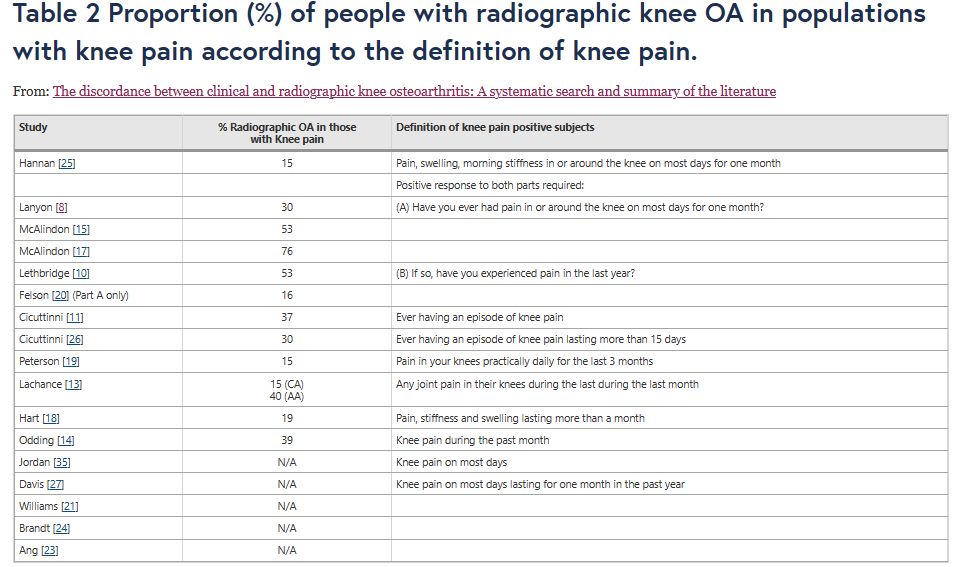

As you can see here the percentage of people with OA and pain varies. It is very common to have a wide range of results for many topics. This is due to many factors including how the research study was designed, and the validity and reliability of the methods used. People might pick just one study to show that they are correct instead of sharing all the data that is available.
Retracted Studies: Then there are the research studies where data was falsified, or methods were poorly designed resulting in retraction of the publication. This means that a research study that was published was proven to have errors or falsification of data by the researchers and removed from their data base. retractiondatabase.org is a searchable site that will list status of research studies. Let’s take a look at some.
Predatory Journals: To make matters worse, there is a list of potentially predatory journals at beallslist.net. There are some journals that will publish anything as long as you pay the application fee. Highly respected journals have a peer review process to weed out poorly designed studies. Some have no review process. and have no integrety. Some are on the list because they are just too new.
Let’s talk about bias and a simple definition by dictionary.com is “a particular tendency, trend, inclination, feeling, or opinion, especially one that is preconceived or unreasoned“. Much like the different types of validity, there are many types of bias. A simple google search found fifteen types! The problem with bias is that it will intentionally or unintentionally effect research.
Examples of bias
Confirmation bias: To search for data that only agrees with ones beliefs or only looking for results that agrees with their beliefs.
selection bias: Selecting research subjects based on specific factors that may influence results. Doing an I phone satisfaction survey of only I phone users. Andriod users may have been unsatisfied with the I phone or prefer androids over the I phone. So a true survey would have both populations.
cultural: making assumptions about different cultures.
survivorship: Many people can drop out of a research study. The remaining test subjects may be a specific population that can skew results.
Financial Interest: it is important to know the financial interest of researchers and the organization or person who funded the study.
For the purpose of this class it is important to understand that our beliefs can effect research.
So it turns out that doing our research is hard work. So there is a lot of issues involving research. Let’s take a quick breather so we can discuss one last topic before getting back to our experiments.
So back to our own project.
Through research, we may find that someone may have already completed our research project that we are interested in and if that is the case, is it important to duplicate the study? There is nothing wrong with redoing a study that someone else has completed because the ability to reproduce similar results strengthens the conclusion. Remember that there is often a wide range of results by different researchers and that is okay. Answers may become ore clear has more data is published.
There are scientists who have found an issue called the “replication crisis” because many research studies cannot be replicated. If a research project cannot be replicated, then how can we trust the results?

Let’s look at an example of reproducibility.
Dr. Epley was an ENT (ear, nose, and throat doctor) who created something called the “Epley Maneuver” to help with vertigo. It is a type of dizziness. In one of his first publications, he reported that test subjects improved 100% of the time as you can see here. This was published in 1991. The only copy that I have is a little blurry. Sorry about that.
Here is a systematic review of research published in 2018 that found 60% of research on this topic were poorly designed! What this means is that we cannot trust some of the research because of how it was completed.

As mentioned, a systematic review and meta-analysis looks at every single study published on a topic with the purpose of collecting and analyzing all of the data available to get as close to the truth as possible.
You may hear people say ‘trust the science”. I say, we need to understand how to interpret science. So back to the topic of the Epley maneuver.
Here is another systematic review that showed 58.9% of a type of vertigo were effectively treated after 1 visit and 18.4% did not do well! So this is a big difference from the original research study.
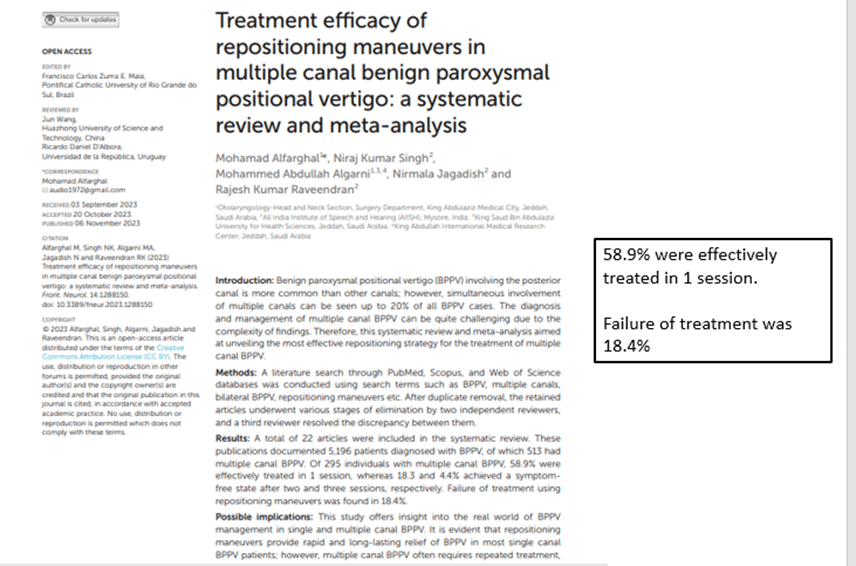
This is an example of the value of duplication of studies. Over time, there will be a better understanding of the topic of research.
With the Epley maneuver, it was found that it is not as successful as the very first study published, there are also more complicated types of vertigo, and there was more failure of treatment that originally reported. That is why we need research to be reproduced.
Of course, not everyone will agree on any topic. This report discusses the limitations of replicability of research. So some feel that the issues with the replication crisis is overblown.

When performing research, we must understand that different opinions can be made based on the same data. Is the cup half full or half empty? Sometimes it can be difficult to know who is right and who is wrong.
As researchers continue to study topics, we can also learn that original theories were wrong.
Have you ever just ridden your bike all day or did something all day and the next day woke up sore? If you look up what causes muscle soreness after exercise or an activity. Many textbooks and websites will state that lactic acid build up is the main cause. But this has been disproven in the 1980s but is still taught today. Lactic acid is actually a source of energy that the body uses during activity.
This bring ups another point. There is something called lag time of research. It often takes an average of 17 years for something to be published to become common knowledge. That is a long time!
I feel like I have been discussing many new topics for our first week and we need a little break. Let’s stand up and do the giggly jiggly or stretch out for a minute or two. We are almost done for today.
Now back to our research questions.
So, What kind of research or information might be out there for some of our topics?
- The 5 second rule: We may have learned that there are things that we can see on food that we dropped such as hair, dirt and etc. But there are other things such as germs and other unsanitary items that may end up on our food that we cannot see.
- Potato to light up a light bulb: Potatoes have acid, water, and sugar that can act like stored energy in a battery.
- Stop sign: By not stopping at a stop sign, there is an increased risk of an accident. A lot of people are distracted when driving which may lead to missing a stop sign.
- Lemonade recipe: There are many recipes that can be found online. A lot of websites list ratings but everyone has different tastes. It is unclear which is the best one.
- Stretching: Many studies have already been completed. It has been found that holding a stretch for a prolonged period of time might be associated with decreased performance and increased injury. There is something called dynamic stretching when we don’t hold a stretch. This is most likely helpful as part of a warmup.
Create a Hypothesis: After researching a topic of interest, a hypothesis is formed. It is a potential answer to the original question that was created. It must be something that can be proven or disproven.
It is common to hear someone say “I have a theory” referring to an idea or hypothesis which is okay outside of science. But a theory in the scientific sense is a concept or hypothesis that is supported by evidence or facts. There are scientific theories such as the theory of relativity, theory of evolution, and germ theory of some examples. We can talk about this later.
For our topics, we can have the following hypotheses:
- The 5 second rule: This is something that can go both ways. Some might create a hypothesis that there is no harm in eating food that is dropped. Others might state that the longer food stays on the ground, the greater the chance it will cause problems when eating.
- Potato to light up a light bulb: A potato has enough stored energy that will travel through copper and zinc wires to light up a light bulb.
- Stop sign: You can make a guess that Only 25 percent of cars will stop through a stop sign.
- Lemonade recipe: After looking up various recipes online. We can guess that 1 cup with lemon juice with 1 cup with sugar will provide the best amount of sweetness and tartness.
- Stretching: Since many studies have already shown that stretches that have static holds decrease performance, it can be redone with different age groups or specific type of athletes.
Now time to think about the experiment: Decide how to test the hypothesis . There are many different types of experiments depending on what will be tested.
- The 5 second rule: Where would this be tested? The kitchen bathroom floor? On the porch? What kind of foods will be tested?
- Potato to light up a light bulb: how this be done safely? What equipment is needed?
- Stop sign: will you stand next to the stop sign or monitor from a place that drivers cannot see? Data collected will vary based on how the tests are performed.
- Lemonade recipe: This one seems kind of simple by trying various levels of sugar and lemon juice. you can have a party and do a taste challenge.
- Stretching: We can read previous research and decide of I want to replicate a study or do something similar but with different types of sports.
Collect data: Gather evidence which can include measurements or observations.
Analyze the data: Where the testing methods valid and reliable? prove or disprove a hypothesis.
Conclude: Make conclusions based on data and discoveries from the experiment. Does the data agree or disagree with our hypothesis.
Report: Report findings which can include publications in order for the experiment to be reproduced.
Here is a video on the 5 second rule experiment. It looks quite fun. Let’s see how they decided to do this experiment. here is the link to the video: DIY Science: Is the 5-second rule true? – YouTube
Here is a video on how to use a potato to light up a light bulb. (1631) Potato Battery Experiment – YouTube
Here is a video of someone monitoring a stop sign for 5 minutes.
I have done my own data collection on stretching here. As a physical therapist, I have shared this with numerous patients. It is dry reading. but it is a simple way to share what we learn. I created a website for my patients after they asked me to have this information easily accessible.
So today we went over concepts of Scientific inquiry and investigation, Scientific method, Hypothesis , and Theory. We went over basic steps of the scientific method. Next, we will go over experimental design. Epidemiology field
 Global Health & Wellness Institute